Saint John Statue
Narcissus and GoldmundThe Saint John Statue is the wooden Apostle John that Goldmund carves in Master Niklaus’s workshop, using the remembered presence of Narcissus to make a figure of devotion, peace, and inward truth. Its completion establishes Goldmund as an artist in the eyes of his master, yet intensifies rather than resolves his conflict with settled life: the work endures, while the act of making it comes to an end and Goldmund feels compelled to move on.
Commission, subject, and training
Goldmund begins the statue after spending a year learning from Master Niklaus. He has become a capable draftsman and has tried modeling in clay, but the John is his first sustained woodcarving project. Niklaus proposes using it in a crucifixion group he has been commissioned to make, where his two assistants have already been working. The subject is not an imagined stranger: the figure represents Narcissus, Goldmund’s closest friend and the guide who awakened him during his years at Mariabronn.
The project grows out of Goldmund’s response to religious sculpture. At a cloister church, he had been arrested by a wooden Madonna made by Master Niklaus, whose living expression seemed to embody an image he had encountered in dreams. The priest explained that the statue was controversial: some considered it too worldly and modern to be a proper image of the mother of God. For Goldmund, however, it demonstrated that a carved figure could carry more than conventional religious decorum. Its beauty helped lead him to Niklaus and to the work through which he would test his own artistic calling.
Niklaus’s workshop offers no ordinary route into the profession. Guild custom expects an apprentice to begin at thirteen or fourteen, serve for years, and have the apprenticeship paid for by his father; only someone who has completed that term can advance to journeyman and master. Goldmund is already an adult, and Niklaus does not want a conventional apprentice in his household. After examining Goldmund’s drawing, which he considers flawed but beautiful, he instead lets him learn informally, without a contract or obligation to stay. The statue thus takes shape outside the standard training path, as a work whose artistic promise exceeds the narrow categories available to its maker.
Making Narcissus visible
Goldmund works on the figure with an intensity he does not bring to every part of his life. Love affairs, dancing, drinking, gambling, and fights sometimes keep him away from the workshop or leave him distracted at his bench. He returns to the statue in hours of readiness, however, approaching it with devotion and humility. In this concentrated work, he feels that he recovers his own skill and soul whenever he loses his way; the figure seems to emerge from the wood with increasing purity.
Goldmund does not understand the finished image as a simple portrait of himself. He says that it is Narcissus, not the carver, who brings light and peace to the statue, and that Narcissus has given the figure into his soul. The distinction is central to his sense of how true art is made: the artist’s hands serve an image that exceeds deliberate self-expression. The work becomes a vessel for the remembered friend, allowing Narcissus’s presence to take visible form beyond the fleeting circumstances of their friendship.
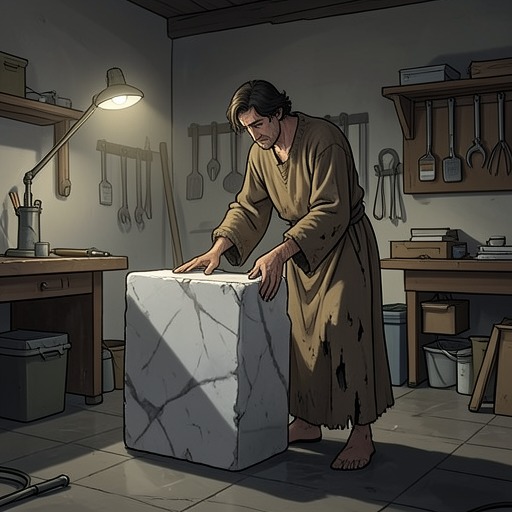
When the carving is complete, Goldmund cleans the small wooden shed behind the assistants’ workshop, brushing the remaining sawdust from the Saint’s hair before standing before the figure for an extended time. He sees Narcissus as the beloved disciple, with a lifted face and a still, reverent expression. The image acknowledges that suffering and death are not absent from Narcissus’s character, while distinguishing him from despair, disorder, and rebellion. In Goldmund’s contemplation, the statue preserves a youthful inward composure that ordinary life cannot preserve unchanged.
Recognition and the end of the work
Niklaus examines the completed statue and calls it good, then very good. He tells Goldmund that he has finished learning and will present the figure to the guild as grounds for making him a master. Goldmund does not greatly value the guild, but he welcomes the recognition because it comes from the master whose judgment matters to him. Niklaus observes that the work is grave but also filled with joy and peace, and remarks that its maker seems to have had nothing but light and joy in his heart. Goldmund answers that the figure portrays his dearest friend, not himself.
Niklaus recognizes a limit that formal advancement cannot remove. He admits that he has made many works inferior to the statue in truth, though not in craft or care, and agrees with Goldmund that such a work cannot simply be repeated. The statue is therefore both a professional achievement and an exception to professional routine: its significance does not arise only from technical competence, and guild recognition cannot guarantee another work of equal force.
For Goldmund, completion is also a loss. While the statue was taking shape, it gave his life in the city a purpose and offered him a refuge and consolation. Once it is finished, it no longer waits for his hands or unfolds under them; he fears being left empty. The next day the work will no longer be his, and the image he most longs to create—the figure of the mother of humanity—remains inaccessible to him. Faced with the prospect of returning to ornamental work, he considers leaving the master, the city, and art rather than continuing without an image that compels him.
Artistic significance and departure
Goldmund understands the statue through a wider meditation on art and mortality. He believes that fear of death and grief at life’s instability may drive artists to make images that outlast their makers. The wooden John gives this thought a particular form: Narcissus’s remembered character becomes fixed in a work that can remain after the living friend and the sculptor have passed away. Yet the preservation is incomplete. The statue can retain an image; it cannot keep Goldmund within the settled life that produced it, or reproduce the singular experience of making it.
The contrast between spiritual image and ordinary craft also shadows the work. Goldmund resists the prospect of spending his ability on decorative pieces made for commissions, comfort, or display. Master Niklaus, by contrast, has responsibilities and reasons to keep his workshop successful, including providing for his daughter Lisbeth. He admires the Saint John enough to try to secure Goldmund’s future: he persuades the guild to grant him a master’s diploma and proposes an equal partnership, shared work on important commissions, and a share of the earnings. His preparations include plans for an enlarged workroom, attic lodging, and new clothes for Goldmund’s guild acceptance.
Goldmund nevertheless chooses to leave. After a painful confrontation, he says farewell to the statue in the courtyard workshop before departing Niklaus’s house. The figure remains the work that proved his exceptional ability and gave shape to his friendship with Narcissus, but it cannot settle the question of what he should make next. Later, back at Mariabronn, Goldmund plans a different commission for the refectory lectern: a two-part design contrasting the created world with the word of God. The Saint John Statue thus marks a completed artistic episode, not the end of his creative life; it fixes one relationship in wood while sending its maker back toward an uncertain future.